Best 13 Things To Do in Frankfurt
Looking for the best things to do in Frankfurt? Germany’s financial capital is often dismissed as a city of bankers and airport layovers – but anyone who stays a little longer discovers a surprisingly charming side. Frankfurt am Main combines a gleaming skyline (locals call it “Mainhattan”) with a carefully rebuilt Old Town, one of Europe’s densest museum landscapes and a cosy apple wine culture that you won’t find anywhere else in Germany.
In this Frankfurt travel guide, I’ll walk you through the 13 best things to do in Frankfurt, from historic landmarks and world-class art to skyline views, river cruises and traditional taverns. For every activity you’ll find practical tips and a link to book tickets or tours, so you can plan your trip in one go. Let’s dive in!
ALSO READ: Best 13 Things To Do in Cologne
1. Explore the Römerberg and the Römer
Every visit to Frankfurt should start on the Römerberg, the city’s historic market square. It is framed by half-timbered houses, the Gothic Old St. Nicholas Church and, of course, the Römer – the stepped-gable building that has served as Frankfurt’s city hall since the 15th century. In the middle of the square stands the Justice Fountain (Gerechtigkeitsbrunnen), one of the most popular photo spots in the city.
Why it’s worth it
The Römerberg is far more than a pretty postcard motif. For centuries, the square was the stage for markets, trade fairs and the celebrations that followed imperial coronations. Today, the Römer balcony is where Eintracht Frankfurt and the city’s sports teams celebrate their titles with fans – so if you’re in town after a big win, you’ll see the square at its loudest.
Tips for your visit
Come early in the morning to enjoy the square without the crowds, or in the evening when the facades are lit up. The tourist information office is located right on the square at Römerberg 27 and is the meeting point for many guided walks.
Book it: Frankfurt Old Town tours and tickets
2. Wander Through the New Old Town (DomRömer Quarter)
Frankfurt’s medieval Old Town was almost completely destroyed in the Second World War. In one of the most ambitious urban projects in recent German history, the city rebuilt its heart: on the historic plots between the Römerberg and the cathedral, 35 houses were built – 15 faithful reconstructions and 20 new buildings in a matching style. The quarter opened to the public in May 2018.
What to see
The highlight is the Krönungsweg (Coronation Route), the historic path between the cathedral and the Römer that newly crowned kings once walked. It was restored to its original route and lowered to its historic level. Take your time in the lane “Hinter dem Lämmchen” and around the Hühnermarkt square, where colourful facades, carved sandstone details and arcades make it hard to believe the houses are only a few years old. The quarter is also home to the Struwwelpeter Museum, dedicated to Heinrich Hoffmann’s famous children’s book.
Tips for your visit
The quarter is small (around 7,000 square metres), so you can explore it in under an hour. Pop into one of the small shops or cafés on the ground floors – around 200 people actually live in the houses, which gives the area a lively, authentic feel.
Book it: A guided walk explains how and why the Old Town was rebuilt – see Frankfurt Old Town tours.
3. Climb the Tower of Frankfurt Cathedral (Kaiserdom)
The Kaiserdom St. Bartholomäus is Frankfurt’s most important church – and, strictly speaking, not a cathedral at all, because it was never the seat of a bishop. Its nickname “Imperial Cathedral” comes from its role in German history: German kings were elected here, and between 1562 and 1792 ten emperors and kings were crowned inside its walls.
The tower climb
The Gothic tower, begun in 1415, rises 95 metres above the Old Town. A climb of 328 steps takes you to the viewing platform at 66 metres, which offers a fantastic panorama of the skyline, the river Main and the rooftops of the New Old Town. In the historic tower keeper’s room, a small exhibition tells the story of the tower’s construction and the great cathedral fire of 1867.
Tips for your visit
Entry to the church itself is free. The tower platform has seasonal opening hours (in winter, for example, Tuesday to Friday 10 am–5 pm and weekends 11 am–5 pm), with last entry 30 minutes before closing – check the Dommuseum website before you go. The Dommuseum in the cathedral’s cloister displays church treasures and historic vestments.
Book it: Tower tickets are sold on site; for a deeper look, combine the cathedral with a guided Old Town walking tour.
4. Take In the Skyline from the Main Tower
Frankfurt is the only German city with a real skyline, and the best place to admire it is from above. The Main Tower rises 200 metres (240 metres including the antenna) and is the only skyscraper in the city with a public observation deck. A fast lift whisks you up to the rooftop terrace, where you can look down on the bank towers, the river Main, the Old Town and – on clear days – all the way to the Taunus hills and the airport.
Why it’s worth it
From up here you finally understand why locals call their city “Mainhattan”. The open-air platform gives you an unobstructed 360-degree view, and in summer it stays open late on Fridays and Saturdays, making it one of the best sunset spots in Frankfurt. On the floors just below the terrace you’ll find the Main Tower Restaurant & Lounge if you want to combine the view with dinner or a cocktail.
Tips for your visit
Adult tickets cost €9 and are sold online; concession, family and Frankfurt Card tickets are only available at the ticket desk on site. Bring a jacket – it can get very windy at 200 metres, and the platform may close in bad weather. The nearest S-Bahn stop is Taunusanlage.
Book it: Main Tower tickets and info (visitfrankfurt)
5. Discover Art at the Städel Museum and the Museumsufer
Frankfurt’s Museumsufer (Museum Embankment) lines the southern bank of the Main with more than a dozen museums – and the jewel among them is the Städel Museum. Founded in 1815 by the banker and merchant Johann Friedrich Städel, it is Germany’s oldest museum foundation and one of the country’s most renowned art museums.
What to see
The collection offers an almost complete overview of 700 years of European art, from the early 14th century through the Renaissance, Baroque and Modernism to contemporary works. Since 2012, the striking underground “garden halls”, lit by round skylights in the museum garden, have added 3,000 square metres of space for contemporary art. Beyond the Städel, the Museumsufer is home to institutions such as the Museum Angewandte Kunst, the Liebieghaus sculpture collection and the Deutsches Filmmuseum.
Tips for your visit
Plan at least two to three hours for the Städel alone. Buy your ticket online to skip the queue, especially during major special exhibitions. Combine your visit with a stroll along the riverside promenade.
Book it: Städel Museum online ticket shop · About the Städel
6. Drink Apple Wine in Sachsenhausen
Forget beer – in Frankfurt, the drink of choice is Apfelwein, lovingly called “Ebbelwoi” or “Äppelwoi” in the local dialect. This tart, slightly sour apple wine is served in traditional taverns, and the district of Sachsenhausen, just across the river from the Old Town, is famous for them.
How it works
Apple wine is poured from a Bembel, a grey-blue glazed stoneware jug, into a Gerippte, the typical glass with a diamond-shaped pattern. If you find it too sour, order it “sauergespritzt” (with sparkling water) or “süßgespritzt” (with lemonade). Pair it with Frankfurt classics such as Handkäs mit Musik (sour-milk cheese with onions) or Grüne Soße, a herb sauce made from seven fresh herbs.
Tips for your visit
Head to the cobbled lanes of Alt-Sachsenhausen for the classic atmosphere, or try the taverns in the Bornheim district, which locals often prefer. For a fun alternative, the historic Ebbelwei-Express tram combines a one-hour city tour with a bottle of apple wine and pretzels – check the current timetable on the official website, as it traditionally runs on weekends and public holidays.
Book it: Ebbelwei-Express (official website) · Guided city walks: Frankfurt Old Town tours
7. Relax in the Palmengarten
Need a break from the city? The Palmengarten in the Westend district is one of the largest botanical gardens in Germany. It opened on 16 March 1871 and goes back to a group of Frankfurt citizens who bought the tropical plant collection of Duke Adolf of Nassau – one of the city’s first civic projects.
What to see
On 22 hectares you’ll find plants from almost every climate zone on earth. The historic Palm House is the garden’s heart, while the Tropicarium, a complex of glasshouses, takes you from humid rainforests to dry tropical landscapes. Outside, the rose garden and rhododendron areas are at their best in spring and early summer, and a small park railway has been running through the grounds since 1972 – a hit with kids. Since 2012, the neighbouring Botanical Garden has also been part of the Palmengarten.
Tips for your visit
Plan around two hours to see the highlights. The garden is open daily all year round, making the glasshouses a cosy escape on grey winter days. The nearest U-Bahn station is Bockenheimer Warte, and the Senckenberg Museum is just a short walk away – easy to combine.
Book it: Palmengarten (official website)
8. Meet the Dinosaurs at the Senckenberg Natural History Museum
The Senckenberg Naturmuseum is one of Germany’s great natural history museums – and a must if you’re travelling with kids (or simply love dinosaurs). More than 10,000 exhibits tell the story of life on earth, including the largest number of dinosaur species on display anywhere in Germany.
What to see
The exhibitions cover today’s biodiversity as well as the evolution of life and the transformation of our planet over millions of years. One highlight is Edmond, a remarkably preserved “dinosaur mummy” of an Edmontosaurus with fossilised skin. In the hands-on Aha?! Science Lab, visitors can examine more than 100 natural objects under microscopes and talk to researchers.
Tips for your visit
The museum is open daily, with late opening until 8 pm on Wednesdays. Adult tickets cost €12; children and teenagers aged 6–17 pay €6, and Frankfurt Card holders get 50% off. Buy tickets online to avoid queues, especially on rainy weekends. Note that there are no luggage lockers.
Book it: Senckenberg tickets and visitor info
9. Step Into Goethe’s World at the Goethe House
Johann Wolfgang von Goethe, Germany’s most famous writer, was born in Frankfurt on 28 August 1749 – in the house on Großer Hirschgraben that you can visit today. He grew up here with his sister Cornelia and lived in the house until he moved to Weimar in 1775. It was in these rooms that he wrote early works such as “The Sorrows of Young Werther” and began working on “Faust”.
What to see
The house was destroyed in the Second World War and faithfully rebuilt; many of the original furnishings had been stored away and returned. Walking through the kitchen, music room and the poet’s study, you get a vivid picture of wealthy middle-class life in 18th-century Frankfurt. Right next door, the Deutsches Romantik-Museum, opened in 2021, explores the Romantic era with manuscripts, paintings and a Goethe gallery. The house and museum are visited with one ticket.
Tips for your visit
Both are open daily (except a few holidays), with late opening on Thursdays. On the first Thursday of the month, the “Feierabend im Museum” evening offers entry for just €1 from 6 to 9 pm. The Goethe House is not wheelchair accessible.
Book it: Goethe House and Deutsches Romantik-Museum – tickets and opening hours
10. Eat Your Way Through the Kleinmarkthalle
If you want to experience Frankfurt like a local, head to the Kleinmarkthalle (literally “small market hall”) on Hasengasse, just a few minutes’ walk from the Römerberg. Around 60 traders sell fresh produce, regional sausages and cheeses, spices, flowers and delicacies from all over the world.
What to try
The most famous stand is Metzgerei Schreiber, where you’ll spot the longest queue in the hall: here you can grab a hot Fleischwurst, the local boiled sausage, served with mustard and eaten standing up. Edel’s stand is a good place to try Grüne Soße, Frankfurt’s famous green herb sauce. Afterwards, climb the stairs to the gallery, where the Rollanderhof wine terrace pours wines from Rheinhessen above the bustle.
Tips for your visit
The market hall is open Monday to Saturday and closed on Sundays. Saturday around midday is the liveliest time, when locals gather outside and on the terrace for a glass of wine. Bring some cash for the smaller stands.
Book it: No ticket needed – entry is free. Want a guided taste of the city? Browse Frankfurt tours and activities.
11. Take a Cruise on the River Main
One of the most relaxing ways to see Frankfurt is from the water. Sightseeing boats depart right next to the Eiserner Steg footbridge and glide along the Main, with the half-timbered Old Town on one side, the Museumsufer on the other and the skyscrapers of “Mainhattan” rising behind them.
Types of cruises
The classic city cruise with Primus-Linie, Hesse’s largest passenger shipping company, lasts either 50 or 100 minutes. In season, boats depart roughly every hour from late morning to the afternoon. The company also runs evening cruises, brunch trips and longer day trips along the Main and Rhine – for example to Mainz, Wiesbaden or Rüdesheim.
Tips for your cruise
Choose the 100-minute tour if you want to see both the eastern and western parts of the city. Sit on the open deck for the best skyline photos, and bring a jacket – it can be breezy on the water even in summer. Frankfurt Card holders get a discount on river cruises.
Book it: Primus-Linie city cruises (official website)
12. Watch the Sunset from the Eiserner Steg
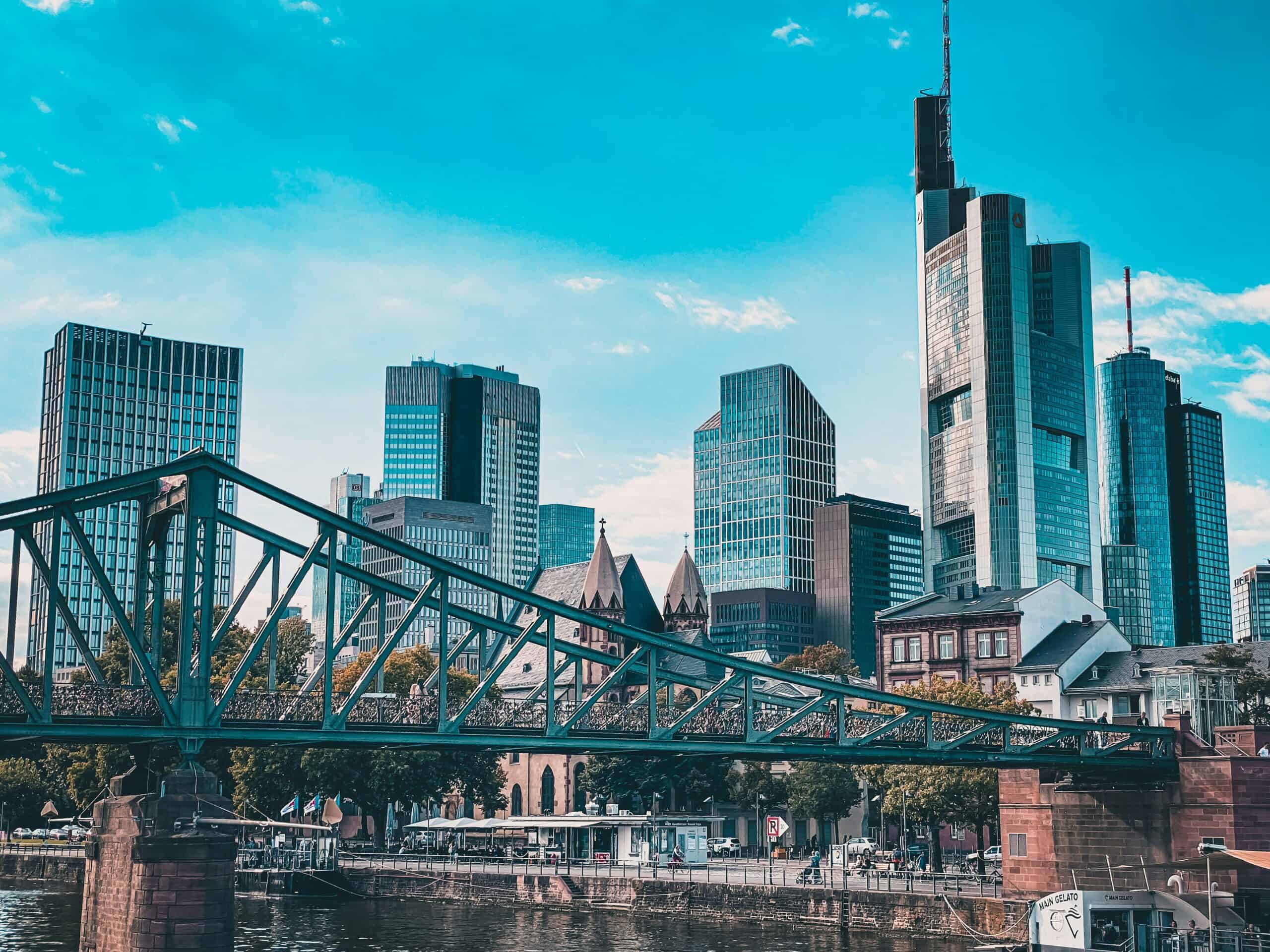
The Eiserner Steg (Iron Footbridge) connects the Old Town with Sachsenhausen and is one of Frankfurt’s most recognisable landmarks. This 19th-century pedestrian bridge offers what many consider the best free view in the city: the river Main in the foreground and the skyline in the background.
Why it’s worth it
The railings are covered in love locks, and in the evening the bridge fills with locals and travellers waiting for the sunset, when the bank towers start to glow. From here, you can stroll along the riverbanks on both sides – the Mainkai promenade on the Old Town side or the Museumsufer on the Sachsenhausen side, which is especially popular on summer evenings.
Tips for your visit
Come about 30 minutes before sunset to find a good spot for photos. Combine your visit with a river cruise (the boats depart right next to the bridge) or continue across to Sachsenhausen for an apple wine dinner.
Book it: Free to visit. For a guided route that includes the bridge, see the Frankfurt Old Town tours.
13. Visit the Frankfurt Christmas Market
If you’re visiting in winter, the Frankfurter Weihnachtsmarkt is a must. First mentioned in records in 1393, it is one of the oldest Christmas markets in Germany. The 2026 edition runs from 23 November to 22 December.
What to expect
The market spreads across six connected squares in the city centre: Römerberg, Paulsplatz, Mainkai, Hauptwache, Friedrich-Stoltze-Platz and Roßmarkt. The Römerberg, with its huge Christmas tree in front of the half-timbered houses, is the centrepiece. Try hot apple wine, a Frankfurt twist on mulled wine, and Bethmännchen, small marzipan sweets that are a local classic. A highlight is the Turmbläser brass ensemble playing carols from the gallery of the Old St. Nicholas Church.
Tips for your visit
The Römerberg gets very crowded in the evenings and at weekends – the stalls around Paulsplatz are usually more relaxed. Families will enjoy the children’s market on the Mainkai.
Book it: Entry is free. Guided Christmas market walks and other seasonal tours can be found among the Frankfurt Old Town tours.
Save Money with the Frankfurt Card
If you plan to visit several of these attractions, the Frankfurt Card is worth a look. It is available as a 1-day or 2-day ticket, for individuals or groups of up to five people, and includes free public transport throughout the city – including trips to and from the airport. On top of that, you get discounts of up to 50% on museums, river cruises, guided tours and other attractions; the Senckenberg Museum, for example, is half price with the card.
Book it: Frankfurt Card 1-day ticket
FAQ: Things To Do in Frankfurt
How many days do you need in Frankfurt? Two days are enough to see the main Frankfurt attractions: one day for the Old Town, the cathedral and the Main Tower, and one for the Museumsufer, Sachsenhausen and a river cruise. With three days, you can add the Palmengarten, the Senckenberg Museum and a more relaxed apple wine evening.
What is Frankfurt famous for? Frankfurt is known as Germany’s financial centre and for its skyline, but also for apple wine, Grüne Soße, its rebuilt Old Town and as the birthplace of Johann Wolfgang von Goethe.
What can you do in Frankfurt on a rainy day? Head to the Städel Museum, the Senckenberg Natural History Museum, the Goethe House or the glasshouses of the Palmengarten – or warm up with a Fleischwurst in the Kleinmarkthalle.
Final Thoughts
Frankfurt may not be the first city that comes to mind for a German city break, but it surprises almost everyone who gives it a chance. From imperial history on the Römerberg and world-class art on the Museumsufer to skyline views from the Main Tower and a Bembel of apple wine in Sachsenhausen, these 13 best things to do in Frankfurt show the city’s many sides. Pack comfortable shoes, book your tickets in advance and get ready to discover “Mainhattan” for yourself.